

How I Got Here
Say you’d picked up a copy of my resume back in 2016 you’d likely have been impressed. Even if you didn’t understand the job titles, you’d have recognized a familiar pattern:
-
Started out at the bottom of a white-collar ladder
-
Worked hard and gradually taken on more responsibility
-
Collected a University degree
-
Held jobs for years at a time
-
Got promoted
-
Became professionally recognized with ‘Chartered’ status
-
Moved to a glamorous overseas posting
-
Added a Masters to my growing collection of qualifications
-
Worked on even bigger projects with management responsibilities
The pattern is one of an ambitious, career-professional, collecting qualifications, and climbing the corporate ladder. In my case, it was a career that started in the construction industry, before specializing in legal and consulting for so-called “mega projects”.
It would have struck you as odd then, that I’d suddenly decide to detonate a land mine under my professional life by quitting to start - of all things - a bagel restaurant. In Hong Kong.
After all, that would have been a line of business that had absolutely zero link to my previous career path. But, that’s exactly what I did: opening Hong Kong’s first true bagel and coffee store with a friend on a sweltering hot July day in 2016. We’d created a place that was meticulously designed, with a menu worked on by not one but two international chefs, and a team we’d cherry-picked from restaurants around the city. Our place was right in the beating heart of the Central business district; packed full of office towers, high-end fitness studios, and endless retail stores. All of which meant it was full of hungry prospects every single day. In potential revenue terms, it was a slam-dunk.
Notwithstanding the obvious potential for this business, it was - as a stranger remarked to me at an industry event not long after the new business had opened doors - “a really weird left turn” on my professional journey. But my career to that point had proven that I’m smart, driven to succeed, and I learn quickly. So, why not? How hard could it be?
As it turned out, very hard, actually: At 12pm that July day, we’d been open for exactly five hours and served just two customers - one of them a friend, the other a former colleague. The restaurant stood empty at what should have been its busiest time, while every other restaurant around us had lines out of the door.
It’s important at this point that you understand neither I nor my business partner were stupid; we each brought skills from different industries to the table and so filled gaps in the other’s knowledge and perspective. We were aware enough to recognize where we needed help and worked hard to do as much as we could to make sure we were successful. Among the hundreds of tiny actions we took to give ourselves a running start we also:
-
Travelled to New York to learn how to make bagels alongside world class bagel experts
-
Spent hundreds of hours of researching the perfect location to set up shop
-
Sourced international chefs to create a luxury fast food product that simply hadn’t existed before in Hong Kong
-
Head-hunted staff who’d make our place somewhere Hong Kong’s highest earners wanted to come back to every single day.
Yet, despite all of this groundwork, there we stood in our expensively assembled restaurant at the most important hour of the day and it was devastatingly empty. There was incredible pressure which no amount of experience from our previous corporate jobs could have prepared us for. Externally we needed to keep our fledgling team motivated, while actually making money to pay the bills (which included their salaries), not to mention remaining outwardly calm should the stressed-out business people we’d built this restaurant for somehow stumble in.
However, it felt as if, the pressure from within my own head was worse. Because, despite keeping my post-quit plans under wraps for months, my old colleagues now knew what I was doing - the cat was out of the bag. This meant my old boss, who wasn’t impressed with either my exit or the abrupt manner of it, also knew. I could only imagine his reaction if he could see that the new venture I’d jumped ship for was sinking fast on day 1.
By this point I’d also told my family, my new girlfriend, and my friends about my shiny new business. In many ways, it was telling those closest to me which created the worst kind of pressure because failure felt as if I was simultaneously letting them down while also shattering some kind of high-achieving image they held of me.
After hearing what I’d done (leaving a career with stable, lucrative prospects) to start a bagel restaurant, every single one of them told me with admiration it was fantastic, that they ‘believed in me’ and “knew” the place would be a big hit.
You’ve probably been in a similar situation before - perhaps taking an exam or facing some kind of personal or professional test where the outcome relies squarely on you. The people in your inner circle act as cheerleaders to give you the open support they believe you need to get over the line. Maybe they tell you they believe in you or that they ‘know’ you’ll be a success - whatever the platitude it’s a show of love that comes from the best place. However, it can end up creating an invisible and very heavy layer of pressure to carry around as you desperately attempt to live up to their image of an achiever, while - in reality - fumbling your way through.
This was a business I’d sunk the best part of my life savings into. I’d also downsized apartments, and used some inheritance money left to me by my parents (of all the investments, this was the one I was terrified of wasting). I’d quit a safe job where I was respected and had a bright future, put my reputation as someone who made good professional decisions at massive risk, and had seemingly created a vacuum into which the rest of my savings were now quickly being dragged and immediately vaporized.
So, had you stood next to me that day and asked how I was feeling about my decision to quit an excellent career to start this business, it’s safe to say I would absolutely have been questioning my decision. Because instead of the sound of chattering customers, the steam wand on our coffee machine working overtime, or of a kitchen in full swing, the only sound you could have heard that day in our empty restaurant was the music coming through our too-expensive speakers - and even that from a playlist we had yet to buy the rights to.
And yet, the decision was exactly the right one: I’d reached a point in my career where I’d stopped enjoying my job years before, and set upon a business idea that had genuine potential. The problem was not the idea - it was the way we’d gone about executing on that idea. Despite all of the hard work and preparation we’d gone to, we had no marketing campaigns running (our Instagram account opened the day before and had precisely 29 followers), no website, and no ready-to-go corporate contact list. That meant there was no guaranteed way of actually filling the restaurant other than relying on friends and word of mouth. I often say that, in a city like Hong Kong, new restaurants have three months to get it right. If they can’t make it work in that time, they either need a very healthy runway budget or face the reality that they’re going to fail. We didn’t have a huge runway and so we needed to figure things out yesterday.
How did we get it so wrong? After all, we were working 18-hour days before we opened doors, so a lack of effort was definitely not the issue. It was that we’d simply not spent the time to figure out what kind of marketing campaign to run, where to run it, or just how important it might be to our Day 1 sales. It was just another ‘thing’ that got left behind in the rush to get things done so we could open doors.
Looking back today, as an expert in business growth and digital marketing, I have the perspective to freely admit that this was an unforgivable, business-killing oversight. It was, however, just one example of the things I’d learn through experience. Had I had some knowledge of what I should have been focusing on to guarantee we’d generate day 1 revenue, I could have completely changed the course of events - both on our first day of operating and in the months afterward. This type of knowledge is, for many first time operators, the ‘known unknown’ - that’s to say you know you’re going to learn a lot when you start operating, but you just don’t know what those things are yet. They’re the things you can only learn by going through something or if someone close to you takes the time to point them out so you don’t fall into the same traps they did. It’s only when you have this knowledge on your side that you gain the silent headstart that makes some businesses take off and others crash and burn. We would have paid handsomely for this kind of headstart - we just didn’t know that one was possible or, given the effort we’d already gone to, if it was even needed in the first place.
So, at that moment, despite having done so much to try and make this successful, our business was heading for the same graveyard in which so many other first-time ventures are laid to rest. The two customers we’d had that day were fifty eight short of the sixty we needed just to break even for the day and this was in an industry with an abysmal record of success for new ventures, in the most competitive and expensive place to start a restaurant on the planet.
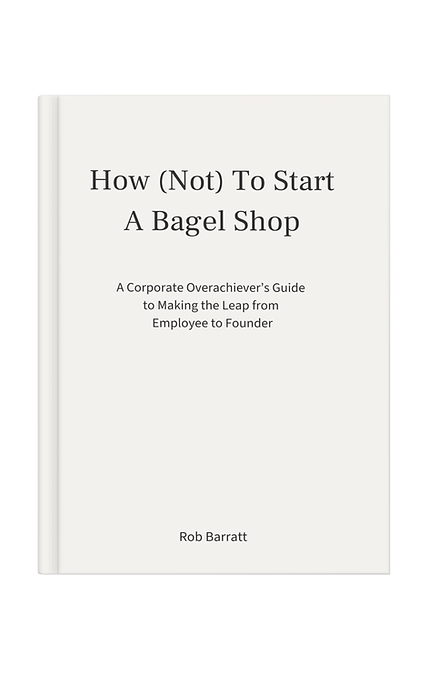
Get Access to the Full Book
Subscribe to our newsletter to receive an exclusive launch discount